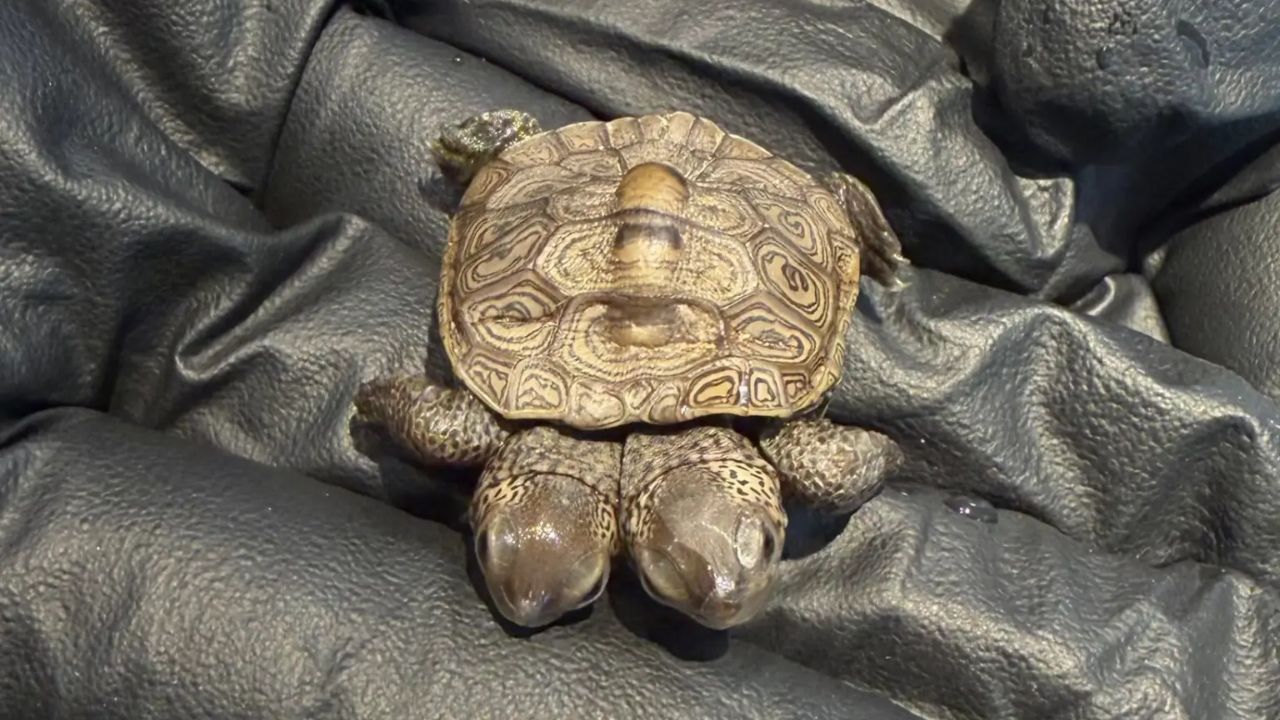
Wellfleet, Massachusetts — A remarkably rare two-headed baby turtle has been discovered at a protected nesting site on Cape Cod, and the tiny hatchling is now being closely monitored by wildlife experts as it continues to survive despite an unusual developmental condition.
The diamondback terrapin hatchling was found last month and weighs roughly as much as a nickel. Wildlife officials identified the turtle as having bicephaly, a rare condition in which an animal develops two functioning heads on a single body.
The hatchling was brought to the Cape Wildlife Center by the Mass Audubon Wellfleet Bay Wildlife Sanctuary, where its health, growth and behavior can be carefully observed.
Tiny Turtle Has a Rare Developmental Condition
Bicephaly generally occurs when a single embryo does not completely separate during the development of identical twins. The result can be an animal with two heads sharing one body.
The Cape Wildlife Center described the discovery as an especially unusual example involving a diamondback terrapin.
“While we’ve encountered this unusual condition before, every case gives us another opportunity to learn more about these fascinating animals’ anatomy and physiology,” the center wrote.
The hatchling is now under close observation as specialists track how its unusual anatomy affects its everyday behavior.
“For now, our team is monitoring this little one’s (two’s?) appetite, growth, and behavior closely.”
For wildlife professionals, the turtle provides a rare opportunity to observe how a young animal with bicephaly develops and responds to its surroundings.
Experts Are Watching the Hatchling Closely
Zak Mertz, CEO of New England Wildlife Centers, which encompasses the Cape Wildlife Center, said the discovery represents an uncommon example of bicephaly in turtles.
“It is fascinating and an area that certainly merits more study,” Mertz told the outlet. “We are excited to care for these two and learn as much as we can to inform future study in the process.”
Mertz said available research suggests the condition may involve both genetic and epigenetic factors.
He also pointed to several possible influences that could contribute to the development of the unusual condition in turtles.
“It may have to do with the relatively long lifespan of the turtles, their preference for returning to the same nesting sites, and a limited gene pool due to their conservation status,” he said.
However, genetics may not tell the entire story.
Environment Could Also Play a Role
Mertz said environmental conditions could potentially influence the development of bicephaly as well.
Factors such as temperature and humidity during incubation, the physical characteristics of nesting sites and potentially environmental exposures affecting the parents could all play a role.
That makes the Cape Cod discovery particularly interesting to researchers because the hatchling may provide additional information about the complicated factors involved in turtle development.
For now, however, experts are focused on the immediate health of the tiny animal rather than drawing conclusions from a single case.
Two-Headed Animals Are Extremely Rare
Although bicephaly is uncommon, the Cape Cod turtle is not the only recent example of an animal developing with two heads.
Other reported cases have included a two-headed porpoise discovered off the coast of the Netherlands and a double-headed dolphin found on a beach in Turkey.
Scientists have also documented unusual cases involving sea turtles.
A 2021 study titled “Two heads are not always better than one” examined double-headed and partially duplicated sea turtles and found that the animals can experience significant craniofacial and spinal abnormalities.
Such abnormalities can make normal movement, feeding and other essential behaviors more difficult.
Students Forced Out of Fort Worth Middle School After Storm Damage Makes Building Unsafe
Survival Can Be a Major Challenge
Researchers have found that two-headed turtles are typically smaller than other hatchlings and can face serious survival challenges because of their abnormal anatomy.
For a newborn turtle, surviving the earliest stages of life is already difficult. Having two heads connected to one body can create additional physical and developmental complications.
That is why this particular hatchling’s continued survival has attracted attention from wildlife experts.
Rather than simply being a curiosity, the turtle could provide researchers with valuable information about developmental abnormalities, turtle biology and the environmental conditions affecting the species.
Why This Turtle Matters to Conservation
Diamondback terrapins live in brackish marshlands along the Atlantic and Gulf coasts of the United States. In Massachusetts, the species is classified as threatened under the Massachusetts Endangered Species Act.
That conservation status makes unusual hatchlings like this one especially important to researchers and wildlife professionals.
Careful monitoring could help experts better understand the species’ health and reproductive challenges while also providing information that could contribute to future conservation work.
For now, the tiny turtle remains under observation at the Cape Wildlife Center, where experts will continue watching its appetite, growth and behavior.
Its survival is uncertain, but every day the hatchling remains healthy gives researchers another opportunity to learn from one of the rarest turtle discoveries on Cape Cod.
What do you think about this extraordinary two-headed turtle discovery? Would you want to see more updates on how the tiny hatchling develops? Share your thoughts in the comments.



One thought on “Wildlife Experts Stunned After Finding a Two-Headed Turtle No Bigger Than a Nickel”