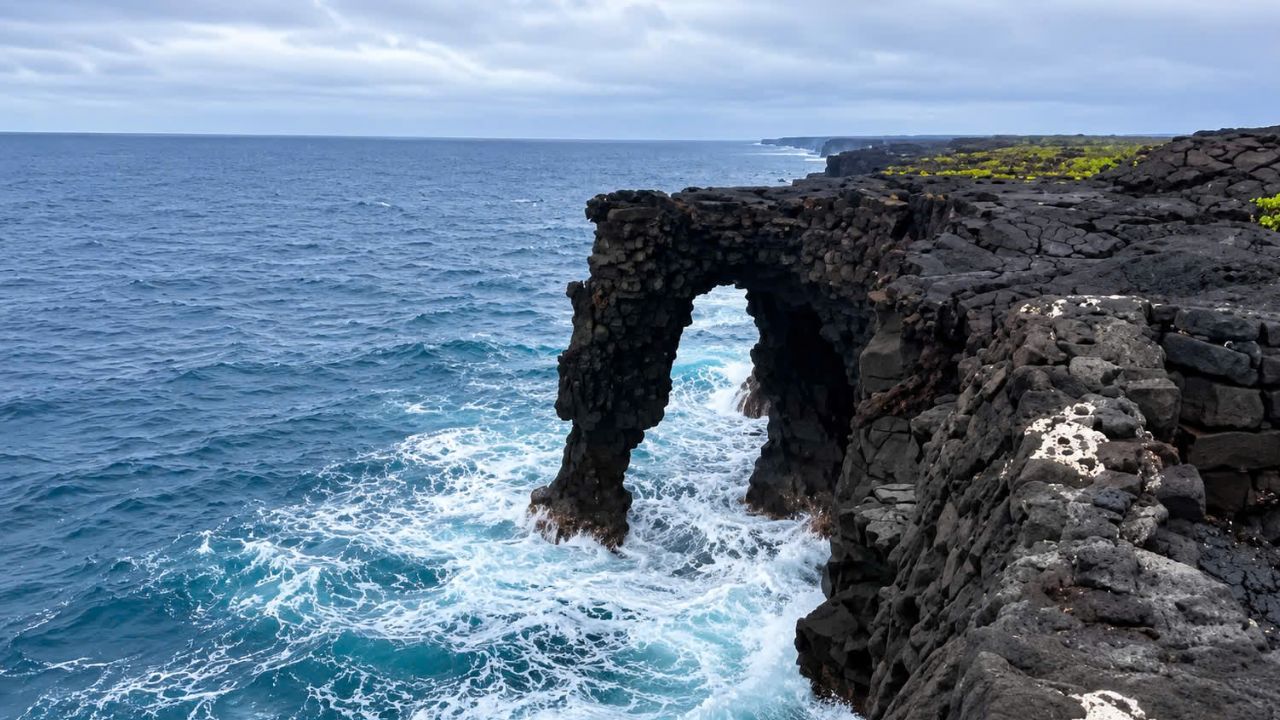
Hawaii Volcanoes National Park, Hawaii — Hōlei Sea Arch, one of Hawaii’s most recognizable coastal landmarks, has collapsed into the Pacific Ocean after weeks of repeated tropical weather battered the state’s rugged coastline.
The approximately 90-foot-tall natural arch was still standing on Sept. 23 but had disappeared by Sunday night, Sept. 27, according to the National Park Service. Officials have not determined exactly when the collapse occurred, but the landmark may have fallen while the park was temporarily closed during Tropical Storm Nolo.
The disappearance marks the loss of a landmark that had stood along the Big Island’s southern coastline for generations.
Tropical Storm Nolo May Have Accelerated the Collapse
The collapse occurred during another period of severe weather for Hawaii.
Tropical Storm Nolo brought heavy rain, strong winds and large surf as its center passed south and southwest of the main Hawaiian Islands. The storm later strengthened into a Category 4 hurricane offshore on Sept. 27.
Large waves battered the Big Island’s southern coast while strong winds affected other parts of Hawaii. Kohala Mountain Road was forced to close because of high winds, adding to the disruption caused by the storm.
The rainfall was also substantial.
Laupahoehoe recorded 21.99 inches of rain, while numerous other locations across the Big Island received more than a foot.
With powerful surf repeatedly striking the coastline, the timing of the sea arch’s disappearance has raised questions about whether Nolo played a direct role. However, park officials have not determined the precise circumstances surrounding the collapse.
The Landmark Was Shaped by Centuries of Erosion
Hōlei Sea Arch was not a recently formed geological feature. The natural opening had been carved into an ancient lava flow dating back approximately 550 years.
Over generations, waves repeatedly attacked the volcanic rock, gradually wearing away weaker sections and creating the distinctive opening that became the iconic sea arch.
That same natural process continued long after the arch became a popular landmark. Eventually, continued erosion weakened the structure enough for the remaining rock to collapse into the ocean.
The disappearance serves as another reminder that Hawaii’s volcanic coastline is constantly changing under the influence of waves, weather and erosion.
Hawaii Has Faced Repeated Tropical Threats
The collapse also came during an unusually active stretch of tropical weather for the islands.
Nolo represented Hawaii’s fourth tropical threat in roughly six weeks, following Hurricane Lala, Tropical Storm Moke and Hurricane Lowell.
Hurricane Lala caused destructive flooding on the Big Island in August, while Hurricane Lowell contributed to widespread power outages on Kauai in early September.
The repeated storms have placed additional pressure on communities that were still recovering from previous weather-related damage when Nolo approached.
The latest storm brought another round of heavy rain and dangerous surf, creating hazardous conditions along portions of the coastline.
Southern States Could Get More Than 7 Inches of Rain as Major Flood Threat Takes Shape
Officials Warn Visitors About Dangerous Cliffs
With the sea arch gone, park officials are also warning visitors about the dangers surrounding the former landmark.
The coastline contains unstable cliff edges that drop vertically into the Pacific, creating potentially deadly conditions for anyone who approaches too closely.
Officials said social media photographs have shown some people entering the closed area around the former arch.
That behavior can put not only visitors at risk but also potential rescuers who may have to respond if someone falls or becomes stranded.
Visitors are being urged to respect closures and remain away from unstable sections of the coastline.
A Landmark That Will Live on in Photographs
Although Hōlei Sea Arch is no longer standing, its memory remains preserved in countless photographs taken over the years.
The park has invited visitors to share their favorite photographs and memories of the landmark, giving those who experienced it an opportunity to document what the natural feature meant to them.
The collapse is a dramatic example of how quickly a familiar landscape can change. For generations, the arch served as a striking feature along Hawaii’s volcanic coastline. Now, only photographs and memories remain of the 90-foot opening that once framed the Pacific.
Did you ever visit Hōlei Sea Arch or see photographs of this iconic Hawaii landmark? Share your favorite memory or reaction to its disappearance in the comments below.
One thought on “Hawaii Loses One of Its Most Iconic Coastal Landmarks as 90-Foot Hōlei Sea Arch Collapses Into the Ocean”