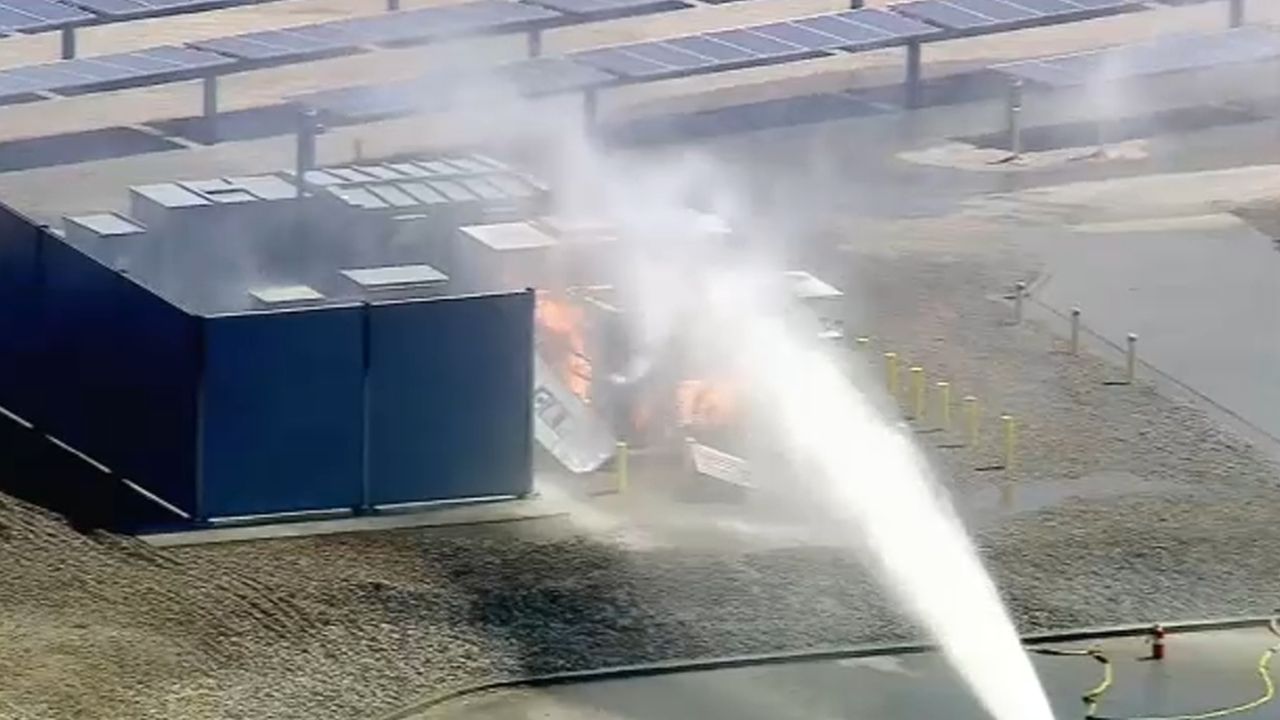
La Verne, California — More than 500 homes remained under mandatory evacuation orders Wednesday after a fire erupted inside a lithium battery storage facility at a Metropolitan Water District of Southern California site, with officials warning that the danger could continue even though the flames appeared to be out.
Firefighters managed to extinguish the visible fire, but the damaged rechargeable batteries remained dangerously hot. Officials said they could still pose a risk of triggering an explosive chain reaction, while smoke from the facility could potentially release hazardous vapors.
Residents outside the mandatory evacuation zone were also urged to remain prepared to leave at a moment’s notice because officials could not yet determine how long it would take for the batteries to cool.
Fire Is Out, But Danger Remains
The fire broke out Tuesday at the water treatment facility, where large lithium battery storage units are used to store energy generated by solar panels.
By Wednesday, firefighters had brought the flames under control. However, the damaged batteries continued producing heat, creating a difficult situation for emergency crews.
La Verne Fire Chief Brandon Coatney emphasized that declaring the area safe would take time.
“The all clear is going to be a long process,” La Verne Fire Chief Brandon Coatney said. “It’s going to involve de-energizing batteries.”
Officials said the evacuation orders would remain in place until the burned batteries could be safely removed from the facility and surrounding area.
Only after that process can authorities reassess whether residents can return home.
More Than 500 Homes Remain Evacuated
The evacuation zone covers more than 500 homes near the water treatment plant.
Police officers went door to door at 504 homes to notify residents about the evacuation orders. Authorities said no one answered at approximately half of those residences.
Officials also found that roughly 20% of residents within the evacuation zone planned to remain at home, despite the mandatory orders.
Fire authorities continued urging people inside the evacuation zone to leave while encouraging residents nearby to keep emergency plans ready in case conditions change.
The uncertainty surrounding the batteries means officials cannot yet provide a firm timeline for when evacuation orders will be lifted.
Burned Batteries Could Still Release Hazardous Vapors
Although officials no longer believed the batteries were at immediate risk of exploding, they remained concerned about heat and possible emissions from the damaged units.
The batteries can continue generating heat even after the visible flames have disappeared. Smoke or a plume could also potentially develop and carry hazardous vapors into the surrounding air.
Coatney explained what officials need to see before they can begin relaxing evacuation restrictions.
“What would be the turning point where we can relax those orders is when heat is no longer being produced and there are no hazardous vapors coming off them,” Coatney said.
That means firefighters and other emergency personnel must continue monitoring the batteries while working to de-energize and remove them.
Firefighters Used Massive Amounts of Water
The scale of the response became clear as firefighters worked to both extinguish the flames and cool the battery units. Crews used approximately 1,500 gallons of water every minute during the firefighting operation.
New images released by the La Verne Fire Department showed the large battery units inside the storage facility. Some of the units were described as being roughly the size of SUVs, with multiple units positioned in rows.
School Bus Carrying 15 Students Crashes in Westwood, Leaving Student and Driver Hospitalized
The rechargeable batteries are designed to store electricity generated by solar panels at the facility.
Evacuees Offered Shelter and Hotel Vouchers
The city established a temporary shelter at the La Verne Community Center for residents displaced by the evacuation.
The center was not offering overnight accommodations, but the city arranged hotel vouchers for people who needed somewhere to stay. As of Wednesday, officials said approximately 30 of the 90 available hotel vouchers had been distributed.
Authorities continued encouraging residents affected by the evacuation to follow official instructions rather than returning home before the area is declared safe.
Officials Say Drinking Water Remains Safe
Despite the fire occurring at a Metropolitan Water District facility, officials said there was no indication that drinking water had been affected.
Authorities said the water remains safe to drink in La Verne and across communities served by the Metropolitan Water District of Southern California, including areas of Los Angeles, Orange, Riverside and San Bernardino counties.
For now, the focus remains on cooling and removing the damaged batteries and determining when surrounding neighborhoods can safely reopen.
Until officials give the all-clear, residents in and around the evacuation zone are being urged to stay alert, follow emergency instructions and be prepared for additional changes.
Would you feel comfortable returning home while the damaged batteries are still producing heat? Share your thoughts in the comments and let us know how you would handle an evacuation situation like this.


One thought on “La Verne Lithium Battery Fire Leaves 500+ Homes Under Evacuation as Dangerous Heat Lingers”