Shishmaref, Alaska — The remains of Tummassak, an Iñupiaq girl who died while attending a government-era Native American boarding school in Pennsylvania in 1900, have finally returned to her Alaskan hometown more than a century after she was taken from her family.
Tummassak was just 12 years old when she died of tuberculosis at the Carlisle Indian Industrial School. After spending her final years far from home, she has now been laid to rest in Shishmaref, a remote Alaska community north of the Bering Strait.
Her return marks an important moment for her community and the broader effort to bring Indigenous children who died at boarding schools back to their ancestral homelands.
Tummassak’s Long Journey Away From Home
Tummassak was taken from Alaska in 1897 and sent to the Carlisle Indian Industrial School in Carlisle, Pennsylvania. She was among the Alaska Native children separated from their communities during a period when Indigenous boarding schools sought to assimilate Native children into mainstream American culture.
According to reporting by the Nome Nugget, Tummassak initially went to Teller Reindeer Station before eventually being sent away to school. She died three years after arriving at Carlisle.
A newspaper clipping from the school’s weekly publication, dated April 13, 1900, recorded her death under the name “Tomicock.” The report described her as a patient and gentle student who endured her illness quietly.
“We are grieved to record the death of another of our Alaska pupils—Tomicock,” the newspaper stated. “She was patient, gentle and brave. She bore her illness in silence. Her smile was ready even when too weak to talk.”
More than a century later, those words offer a glimpse into the life of a young girl whose story might otherwise have remained largely unknown.
Research Helped Bring Her Remains Back to Alaska
The Alaska Native Heritage Center spent years researching Alaska Native students who died while attending the Carlisle school. That work helped make Tummassak’s return possible.
Researcher Nyché Andrew developed a personal connection to Tummassak after discovering similarities between the young student and her own great-great-grandmother.
Andrew told the Nome Nugget that she was struck by how closely the two appeared to resemble one another, including their traditional facial tattoos, known as tavluġun. She believes they may have been distant relatives, although she has not established exactly where Tummassak fits into her family tree.
“I was very shocked, a little bit confused because of how strikingly similar they were, and also very perplexed by their similar tavluġun tattoos,” Andrew said.
The discovery added a deeply personal dimension to the research, connecting historical records with living family memories and cultural identity.
A Burial Ceremony Brings Tummassak Home
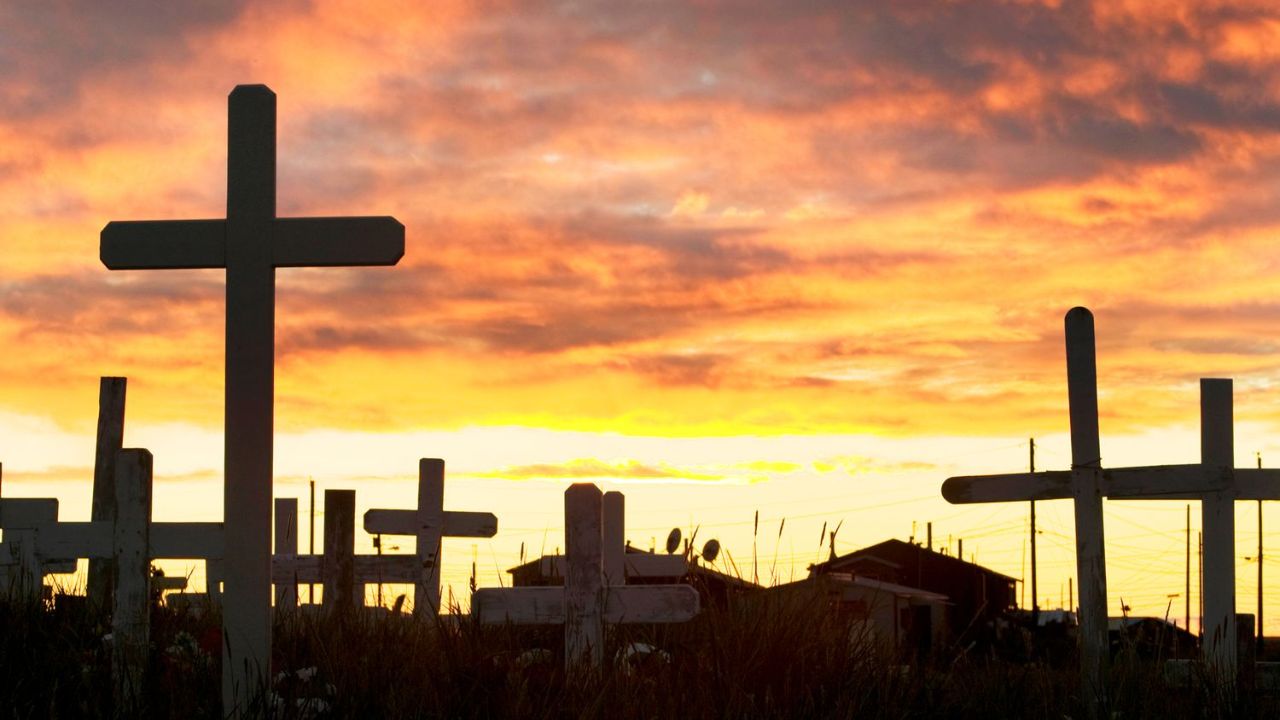
A repatriation and burial ceremony was held on October 4 at Shishmaref Lutheran Church, according to the church’s Facebook announcement. Tummassak was subsequently buried in her hometown.
For Andrew, the return represented more than the recovery of historical remains. It meant bringing a young girl back to the landscape and community from which she had been separated.
Andrew described the difference between Tummassak’s former resting place and her new burial site.
“Her view now is better,” Andrew said. “There’s not a noisy road. There’s not military personnel with all their security measures wandering the place. There’s none of that. She just has a beautiful lagoon to look at.”
Andrew also described the responsibility of helping bring Tummassak home as an overwhelming experience.
“the hardest thing I’ve ever gotten to do in my life.”
The return has given Tummassak a resting place in the community connected to her origins, allowing her story to be remembered closer to home.
The Wider History of Native American Boarding Schools
Tummassak’s experience reflects a much larger chapter of American history. According to the National Park Service, Native American boarding schools expanded following the conflicts of the 19th century, with children from more than 100 Indigenous groups sent away from their families.
These institutions frequently sought to replace Indigenous languages, traditions and cultural practices with those of mainstream American society. Children were separated from their families and communities, often with limited opportunities to maintain their cultural connections.
Colorado Grandmother Follows Fake Apple Support Instructions and Loses $36,000 in Shocking Scam
In 2021, then-U.S. Secretary of the Interior Deb Haaland launched a federal investigation into the history and legacy of federally supported boarding schools. The investigation documented evidence of physical and emotional abuse, sexual abuse, racism and poor living conditions. Many children also suffered illnesses that proved fatal.
Speaking in 2022 about survivors’ accounts during the Department of the Interior’s Road to Healing listening tour, Haaland said:
“I’m human, and it’s hard not to cry,” Haaland said. “It’s almost like the folks at these schools got together and decided how to best make these children’s lives a living terror.”
The listening tour was established to document the experiences of survivors and their descendants.
A Return That Carries Meaning Across Generations
Tummassak is among 31 children from the 20th century whose remains were recently repatriated to Alaska, according to the report.
Her return highlights the continuing efforts of Indigenous communities and researchers to identify children who died far from home and restore their connections to their ancestral lands.
For Shishmaref, Tummassak’s burial brings an important part of its history closer to the community. Her story also serves as a reminder that the consequences of forced separation continued long after the boarding schools themselves became part of the historical record.
After 126 years, Tummassak has finally been laid to rest in her homeland, where her memory can be honored by the people and landscape to which she belonged.
What are your thoughts on efforts to return Indigenous children who died at boarding schools to their ancestral communities? Share your perspective in the comments.