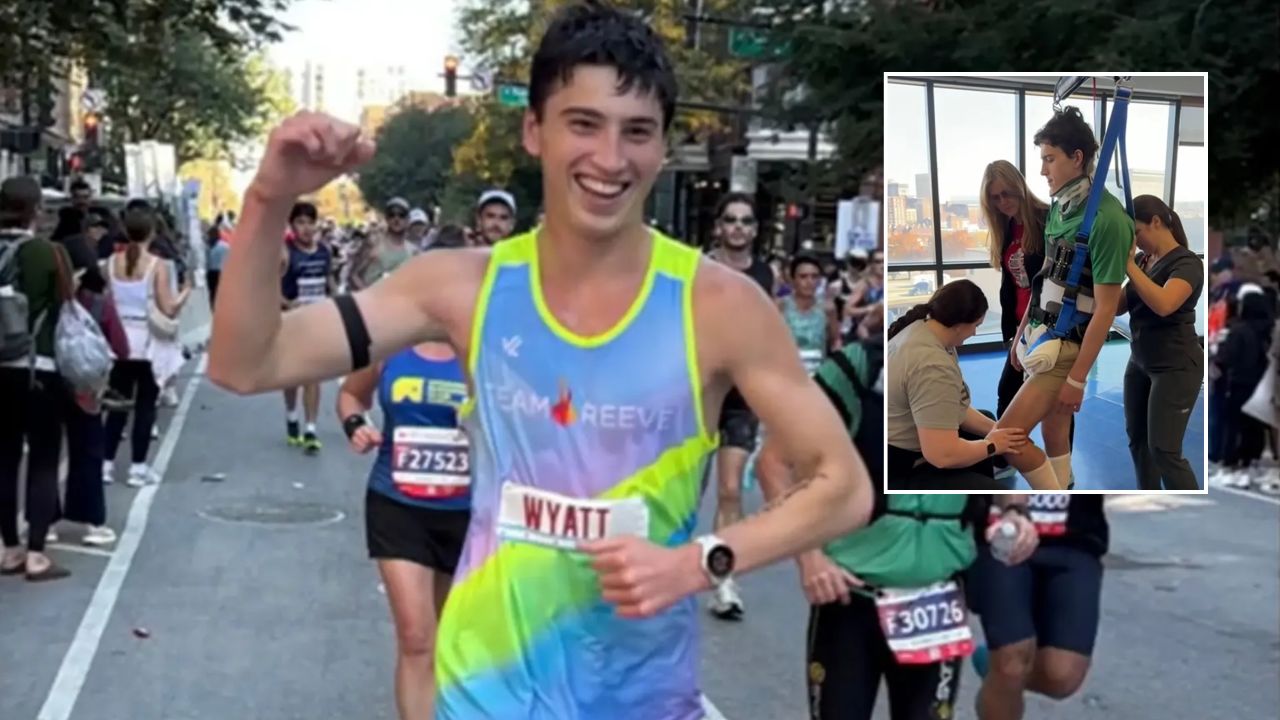
Louisville, Kentucky — A 17-year-old Kentucky high school senior has achieved a remarkable milestone after completing the Chicago Marathon less than a year after a serious spinal injury left him unable to move his limbs.
Wyatt Anderson crossed the finish line of the Bank of America Chicago Marathon on Sunday with a time of 3 hours, 56 minutes and 28 seconds, according to ABC News. His achievement came months after a basketball accident left him fearing he might never walk again.
For Anderson, the 26.2-mile race represented more than a personal athletic accomplishment. It marked the culmination of months of surgery, rehabilitation and determination to regain the abilities he once took for granted.
Basketball Accident Left Teen Unable to Move
Anderson’s recovery journey began last November when he was playing basketball with friends. While going for a rebound, he tripped over his own feet and struck his head against a wall. The impact fractured his spine and left him unable to move.
“I blacked out right after for a little bit, and I couldn’t move any limb on my body,” Anderson told.
The injury required spinal fusion surgery, followed by months of rehabilitation. Anderson had to work to regain movement and relearn how to walk, facing uncertainty about whether he would return to his previous activities.
The experience also brought difficult questions about his future.
“Every single day, it was in the back of my head, I was like, ‘Am I gonna walk again? Am I gonna be able to do the same thing that I was doing two weeks ago, a day ago?’” he said.
A Rehabilitation Story Sparked a New Goal
During rehabilitation, one of Anderson’s therapists shared a story about a man who completed 50 marathons in 50 states in a single year while using a wheelchair. The story made a lasting impression on the teenager, giving him a new goal to work toward as he continued recovering.
“That just, like, blew my mind and motivated me,” Anderson said.
As his movement gradually returned through physical therapy, he began thinking beyond simply recovering from his injury. He wanted to accomplish something that had once seemed out of reach.
His goal was to walk or run a marathon within a year of his accident.
Anderson acknowledged that the recovery process was not always easy. There were moments when he questioned whether things would improve, but he continued focusing on progress rather than setbacks.
He said he reminded himself that “every day is a step forward” and to “just say yes to every opportunity.”
From a Half Marathon to Chicago’s 26.2 Miles
Anderson took an important step toward his goal in April when he completed the Kentucky Derby Festival miniMarathon, a 13.1-mile half marathon.
That race offered a significant milestone in his return to running, but Anderson had a bigger challenge in mind: the Chicago Marathon.
On Sunday, he lined up for the race alongside his brother, Jack Anderson. Together, the brothers set out to complete the demanding course while also supporting a cause connected to Wyatt’s recovery journey.
Wyatt finished in 3:56:28, reaching his goal less than a year after the accident that had left him unable to move.
His story illustrates the determination required to rebuild physical abilities after a serious injury, while also highlighting the role rehabilitation and encouragement can play in helping someone pursue new goals.
Brothers Raise More Than $24,000 for Spinal Cord Injury Support
The Anderson brothers also used their marathon participation to raise money for the Christopher and Dana Reeve Foundation.
The organization supports research, advocacy and resources for people living with spinal cord injuries. According to the foundation’s website, the brothers raised more than $24,000 through their effort.
For Wyatt, the race also offered an opportunity to encourage other people facing difficult circumstances to set ambitious goals.
“I hope my story will help other people want to set a lofty goal for themselves and to believe that nothing’s impossible,” he said.
He added: “[You] can do anything if you set your mind to it — truly, I mean, coming from someone who couldn’t walk at a time and now is running.”
Less than a year after a frightening accident changed his life, Anderson crossed one of distance running’s most demanding finish lines. His journey from spinal surgery and rehabilitation to the Chicago Marathon has become a powerful example of setting a goal and continuing to work toward it, even when the outcome remains uncertain.
What do you think about Wyatt Anderson’s incredible comeback? Share your thoughts and encouragement for him and his brother in the comments below.